
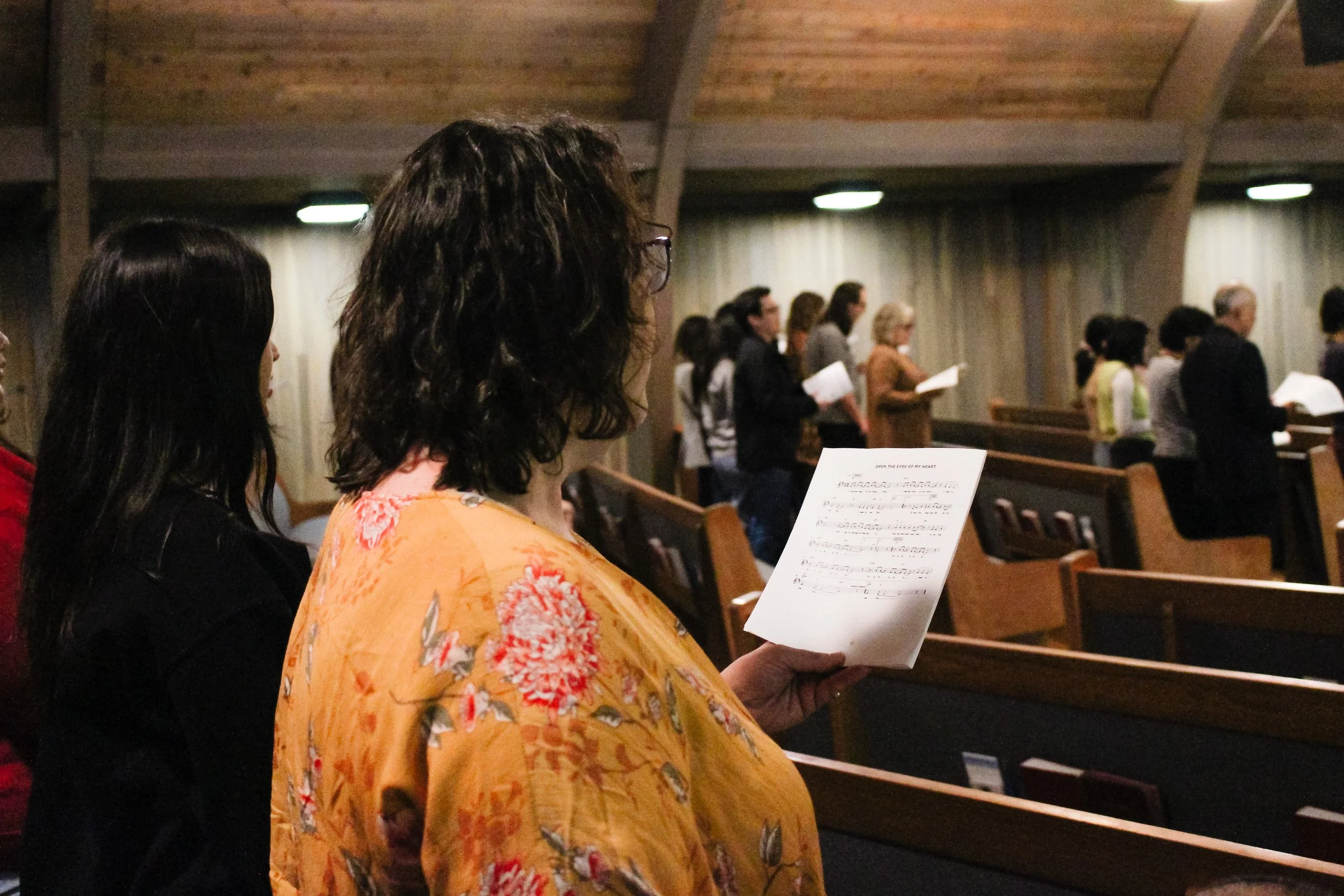
Hammering in the Nails
For we live in a stormy and turbulent world seeking to disrupt what’s sacred in what’s built through and by God’s Word. All of us bring the inner antagonist with us into whatever community we join. But we can be certain that God’s overwhelming grace and promises are far more powerful and compelling than what maladies we bring in with us. And his Word is more indelibly carved into our Father’s records of us than any mistakes we’ve made by the virtue of Jesus’ perfect righteousness. Trusting in his unfailing promises, we hammer in one nail at a time.
I’ve often been called an optimist — and not for good reason. There’s always been, I’ve found, traces of disapproval in the tones of those who diagnose this of me. And it’s true, I’m often naively optimistic, saying in truest caricature: “Smiling’s my favorite.” But optimism without hope is something Tom Wright calls a fuzzy optimism. And when floating and drifting rudderless, there’s really no journey I’m afraid to undertake. But something I’ve learned the hard way — pastoring a church will slap that smile right off of your face, as it’s no place for fuzzy optimists.
Three years ago, our church Christ Our Redeemer embarked upon a new journey through this thing called a church merge. And prior to merging these bodies into one church, a mentor of mine shared an analogy that stuck with me — that a church is much like a cruise liner and not a speedboat, because you can’t just pivot on command. New churches, likewise, don’t just happen but require planning and preparation that mitigate the possibility for these turns to amount to disastrous collisions and shuffles. And in these early steps in our church’s infancy, our intention has always been to plan and to prepare.
And that’s where Noah teaches us a great lesson. What we often remember in the Noah narrative is the event of the Flood. And how could we not? With a sizable boat preserving two of each animal and eight humans from the incessant rain pouring from the heavens, the plot travels quickly from gathering to gloom to the rainbow. But something that gets criminally overlooked in the narrative is Noah’s preparation. There’s debate on exactly how many years it took for Noah to build the ark, but the general consensus is that it took a really long time.
You might recall that Hollywood had its own take on the Noah story. And one of its many (depending on who you ask) errors in the film is the inclusion of the antagonist. They just had to let a bad guy into the ark, because Hollywood, much like the general public, severely underestimates the inner antagonist in all of us. And while John Calvin was very well aware of that inner antagonist of our sinful flesh, he was equally aware of God’s grace and mercy. In his commentary, he called the ark as the first picture of the church in a fallen world — where God holds securely those belonging to him as set apart from what’s outside the walls. For a significant detail with the ark is that it wasn’t Noah but “the LORD [who] shut them in” (Gen 7:16). For he who shut them in holds himself responsible for ensuring the preservation and security of those sealed within the walls of the ark. And with anything outside of God’s help, what we hold to is that fuzzy optimism that amounts to wishful thinking and an increasing uncertainty.
For Noah had planned and prepared for years with the certainty that God would do exactly as he would — protect and preserve those in the ark from what was beyond the walls of the ark. And what was it that Noah had constructed? We know it as the ark, but this was an extremely oversized wooden box with no steering capabilities. And while I don’t call life in the church an aimless or directionless endeavor, something that I learn from Noah is that much of the preparation Noah undertook was not to pave his own steps or directives.
I’ve heard numerous times the words of Tim Keller, when answering questions about what he wished had done different as a younger church planter. And each time, his answer remains the same — more prayer. Perhaps, this isn’t what the young and eager church minister or leader in the church is expecting to hear. We want missional strategies and growth methods. We want tools and tricks to maximizing the all-important scarcity of time. But what Noah and many of the matriarchs and patriarchs who have gone before show us is that man’s pursuits are aimless if they’re not guided and anchored by Word and prayer. And here, we pause and reflect on how Noah’s story teaches us about church in the modern world. For we live in a stormy and turbulent world seeking to disrupt what’s sacred in what’s built through and by God’s Word. All of us bring the inner antagonist with us into whatever community we join. But we can be certain that God’s overwhelming grace and promises are far more powerful and compelling than what maladies we bring in with us. And his Word is more indelibly carved into our Father’s records of us than any mistakes we’ve made by the virtue of Jesus’ perfect righteousness. Trusting in his unfailing promises, we hammer in one nail at a time.

What Is Advent?
Because Advent is not a season where we suppress the sad stories. But we let them all hang out. For it’s into this kind of world that Jesus committed himself into. He was born into the bloody mess of a manger and into the story of scandal in the virgin birth. Jesus knows about all that’s broken and messy within and around you. And he invites us that we let one another know as well.
The word Advent comes from the Latin word ‘adventus’ which means ‘arrival.’ Its verb form ‘advenire’ means ‘to come.’ The season of Advent is a season of waiting — waiting for one to come. For when he comes, all things will be made new, pain will be washed away, tears will be wiped away, and death will be no more. He came once, and we trust that he will come again. And every Advent season, we approach this season in this same anticipation. N. T. Wright likens the rhythms of the liturgical church calendar to spokes on the wheel of a bicycle. Just as the spokes hit the ground rhythmically and in order, we likewise enter into each season of the liturgical church calendar. In our church calendar, we go from Advent to Christmas to Epiphany to Lent to Easter and to Pentecost. And just as the traveler might expect to sojourn from one place to another with the expected spokes that land on the ground, we move into each calendar year as sojourners who move from one part of life to another. And as we enter each season rhythmically and in order, we trust that our God travels with us and gives us the tools we need to travel from one season to the next.
“The reality is that time is a stream we are swept into. Time is a gift from God, a means of worship. I need the church to remind me of reality: time is not a commodity that I control, manage, or consume. The practice of liturgical time teaches me, day by day, that time is not mine. It does not revolve around me. Time revolves around God — what he has done, what he is doing, and what he will do.”
- Tish Harrison Warren
We enter into this practice, as God’s people always have. Just as Israel had built in rhythms and festivals to remind them of their redemption, the great story of the Exodus, the church enters into these rhythms to cultivate the practice of reorienting our often disjointed days to the Author of life, whose ultimate Story anchors us through all of life’s tumultuous waves, as the one ties and holds all parts together.
In the Advent season, we join in with our siblings of faith in the past, who were longing for the first Advent of Jesus. In the protracted silence of 400 years (ten generations), the prophets of Israel had not spoken. They were waiting for one to come, to burst through the silence and into the darkness. They were waiting for a King to come to rescue them and to fulfill all the promises of written for and to them from the penmanship of our God who never reneges on any of his promises. And so, when Jesus came to his people in the incarnation, it was to fulfill something long awaited and longed for. And while we reflect back upon the incarnation, where the Author of life entered into the plot as the “Word who became flesh and dwelt among us” (Jn 1:14), we join in with the longing of God’s people past, present, and future. For we are all longing for Jesus to come again. And the promise of the Scriptures is that when he comes again, he comes yet again to dwell with his people.
Behold, the dwelling place of God is with man. he will dwell with them, and they will be His people, and God himself will be with them as their God. He will wipe away every tear from their eyes, and death shall be no more, neither shall there be morning, nor crying, nor pain anymore, for the former things have passed away.
- Revelation 21:3-4 (ESV)
For we look around us, and we may observe the brokenness and maladies of our surroundings. Some of us may have observed sad moments in this past year. Some of us may be reminded of sad stories each time the holidays come around. Some of us may be going through seasons of hurt right now. And perhaps, some of these deep hurts that haven’t been given air. Whether it’s missing someone or grieving some for of loss, Advent is the season that doesn’t push away the tears but gives meaning and fuller definition to the sadness and heartbreak. Advent joins our silenced hurts with the myriad of people who were longing for our Savior in silence. In the midst of it all, God has not left us. But in fact, he is and has always been ever present in our laments and sorrows.
Some of us may observe repeated cycles of sin that happen around us or even within us, and we’re longing for Jesus to come and to put a halt to these habits and patterns. We believe in a Story where love conquers over evil and hatred. And yet, when winds of evil and wickedness blow through and into our dwelling places, we are left wondering when our God will seal us away from sin and evil once and for all. Because Advent is not a season where we suppress the sad stories. But we let them all hang out. For it’s into this kind of world that Jesus committed himself into. He was born into the bloody mess of a manger and into the story of scandal in the virgin birth. Jesus knows about all that’s broken and messy within and around you. And he invites us that we let one another know as well.
In this season of Advent, we come in trust of our God who came to be amongst us and promises to be with us. For Immanuel — God with us — is not only his name but his everlasting commitment. That Jesus is ‘God with us’ — in the midst of the storms, in the midst of the darkness, in the stillness of sacred wonder, and in the promise of making all things new.

Being a Story-Formed Community
Because at the heart of it, we all nurse wounds and carry trauma living in a world absent from what the Bible calls Shalom (true peace and flourishing). And when I experience something real, something that strikes a nerve, I’ve come to learn, is that pain has a history that often sets off an automated response. But sometimes, a story into another world can lull our sensitivities. And in some unique way, these stories spare us from nudging the purpling bruises on the surface and instead, reach deeper into the heart and soul to peel what’s been masked and taped over with years of self-preservation. We all need healing, and some of us need deep healing. And deep healing, as expressed by Wendell Berry, among others, happens not just with stories but in deep community.
I once stumbled upon an interview involving a man who customarily reads something around 300 novels each year. When asked why he reads so much, he answered that the illusion of escaping reality mesmerized him with each novel. For him, it was not so much an ambition to read so voraciously but a necessity to keep his sanity. You see, reading novels had become his drug, his means of self-medication. For escaping into these stories — though placed in fantasy realms — numbed his senses from facing the pains of everyday reality.
And there’s something provoking about such honesty. Because at the heart of it, we all nurse wounds and carry trauma living in a world absent from what the Bible calls Shalom (true peace and flourishing). And when I experience something real, something that strikes a nerve, I’ve come to learn, is that pain has a history that often sets off an automated response. But sometimes, a story into another world can lull our sensitivities. And in some unique way, these stories spare us from nudging the purpling bruises on the surface and instead, reach deeper into the heart and soul to peel what’s been masked and taped over with years of self-preservation. We all need healing, and some of us need deep healing. And deep healing, as expressed by Wendell Berry, among others, happens not just with stories but in deep community.
There’s a movie that I partially watched with my wife Judy some time back called The Jane Austen Book Club. I remember bits and parts of it, as I’m pretty certain our kids schemed a rotation of waking up in the middle of the movie. But the plot of the film is pretty simple — a community is formed around the sharing of a book. And you find all kinds of characters that gather around and into this book club — middle-aged women, single men riding bicycles, divorcees, those looking for love, those taking a break from love. These characters who wouldn’t otherwise be found in regular community with one another made the habit of convening once a week to discuss the words of a dead author from a book published centuries before. And albeit it fictional, something like The Jane Austen Book Club shows the congregating effect of stories.
And if a dead author like Jane Austen can create community — a diverse and committed community — then, what might a living author do? Because among other things, that’s what church is. We’re a book club. Our book just happens to be living and active, with an eternally present author. Which is why Stanley Hauerwas calls the church a text-formed community. We are a gathering of people of different times, places, and spaces. But we share in a common text, a common story that gives definition to who we are as individuals and as a community.
When recounting the distinct purposes with the series, J. R. R. Tolkien described The Hobbit to be an adventure, while The Lord of the Rings a quest, a journey. The adventure, Tolkien explains, is best understood as ‘there and back again.’ It’s filled with fun and excitement involving with these moments of thrill that come in spurts. But a quest is one that necessitations not exhilaration and anticipation but steady preparation and grit. And I wonder if that’s why sometimes life is so difficult to manage — because we expect an adventure without proper vision for a journey.
But to last on the road, we must all prepare for the quest, the journey, with a compass to help us keep our paths. Some of us have broken compasses, and so, we’re called into community. We walk, and we stumble in community. Sometimes, we wander off from community. But our broken compasses find recalibration through a voice that calls out to us. And it’s a Shepherd’s voice that calls out to His sheep. And He not only assembles to Himself a diverse gathering, He commits to walking alongside us as our guide. As Douglas McKelvey notes, the best of stories rhyme. And when our lives converge with the Bible, our needs find our every rhyme in Him, who is our Shepherd, our guide, and the Author of life.
And in this next season, that’s what we’re aiming for as a church. We want to be shaped by, gathered around, and deeply invested in God’s Word and our communal study of it. From Sundays to midweek study groups, we pray the Author of life might breathe life into our study of His Word to our becoming a text-formed community. And so, we commit to walking together with Jesus as a Story-formed community. For He has not only written the pages, He’s written Himself into the plot. And thus, He’s paved the roads He’s called upon us to walk, the very grounds He Himself has traveled in deepest experience. While we fret over beginnings and ends, He’s seen this journey through, and so He’s locked in on our present. So, we take steps together in confidence, though we may often lack courage. As C. S. Lewis reminds us, as long as we have the will to walk, God is pleased even in our stumbles.
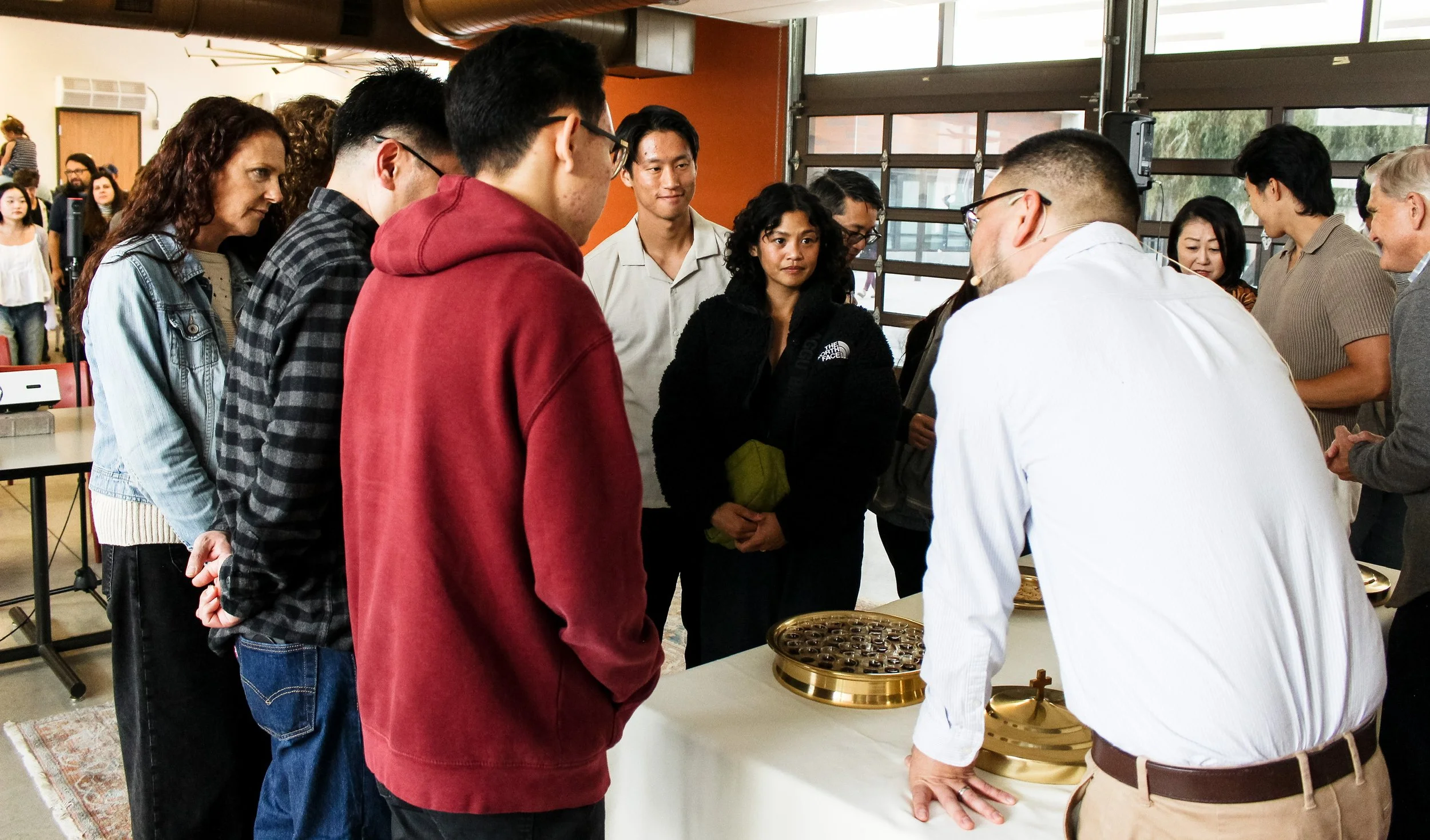
Who is this church for?
Our commitment is toward grace. Grace for the legalist whose own demands strangle his heart. Grace for the tired parent distracted, neglecting, and scrolling. Grace for the addict desperately looking for a greater power than self-medication. Grace for the single mom overcompensating for burdens she shouldn’t have to shoulder alone. Because while God’s grace is deep, it’s not something we carry — it’s something we fall into. At Christ Our Redeemer, we like to say that we recline into God’s grace and into friendship with Jesus. Not because laziness is the answer, but because in the Story of the Gospel, we aren’t the protagonists. And so, we don’t have to play the main part — that’s left to someone else. And He’s faithful enough to carry the mantle, to carry the cross, to carry our burdens, to carry us to His grace — that same grace we fall into.
In the film Apollo 13, there’s a scene involving Tom Hanks’ character Jim Lovell where he’s laying on a hammock next to his wife, as they gaze out into the night sky. This is the night before Jim’s set to take off into the uncertainties of outer space in quest to set foot on the moon. And with a certain calmness, he measures his thumb to cover the moon with one eye closed. And as he’s doing so, he tells his wife Marilyn, “Christopher Columbus, Charles Lindbergh and Neil Armstrong. Neil Armstrong. From now on we'll live in the world when man has walked on the moon. It's not a miracle. We just decided to go.” Of course, there’s so much more that preceded the launch of astronauts than just deciding to go. There were teams assembled with members added and discarded. There were plans prepared, scrapped, adjusted (rinse and repeat). In order to send these astronauts to the moon, there were countless hours and people who played a role behind the scenes. Nothing is ever quite as simple as it seems.
A couple Sundays ago, our church celebrated our two year anniversary since our launch day. We weren’t sending anyone to the moon, but it was a day we committed to doing our best to be “Gospel astronauts.” That as a Gospel heralding church, we might commit to providing an atmosphere of grace and reprieve in a world filled with shame and hurts. Not because we’re anything special, but the one who commits to stay amongst us is He who entered a hostile world and set foot on the soiled terrains of our sinful enactments and severances. Which is why we celebrated two years — because He’s been with us, and we believe He’s cultivating something special for Himself and to the glory of our Triune God. So, as much as we can, we create moments to enjoy God, one another, and laugh. G. K. Chesterton once said of laughter that it’s the “reentrance of wonder.” And while there are always circumstances and hardships that seek to muddy that entrance and reentrance, our wonder is recaptured when we look up. Because that’s the thing about slips and stumbles. When your face is too close to the ground, the smell of the dirt becomes more proximate than the smell of the roses.
And so, God lifts our chins to enter and to reenter seasons of wonder — to smell the roses and to live out Gospel anticipations. Sure, troubles will come — they always have and always will. And stumbling is what toddlers do, and so, it’s what we expect out of a toddler aged community. But our commitment is toward grace. Grace for the legalist whose own demands strangle his heart. Grace for the tired parent distracted, neglecting, and scrolling. Grace for the addict desperately looking for a greater power than self-medication. Grace for the single mom overcompensating for burdens she shouldn’t have to shoulder alone. Because while God’s grace is deep, it’s not something we carry — it’s something we fall into. At Christ Our Redeemer, we like to say that we recline into God’s grace and into friendship with Jesus. Not because laziness is the answer, but because in the Story of the Gospel, we aren’t the protagonists. And so, we don’t have to play the main part — that’s left to someone else. And He’s faithful enough to carry the mantle, to carry the cross, to carry our burdens, to carry us to His grace — that same grace we fall into.
And whether you’ve been walking with the Lord for decades or have taken your steps far from a relationship with Christ, we all need the same grace. And we all visit the same well of grace each Sunday. So, who is this church for? It’s for anyone who’s looking for rest from the fatigue of everyday, who embody the words of Albert Camus — that the “weight of days is dreadful.” It’s for anyone who’s alone and needs meaningful and intentional community — one that’s not perfect but leans into perfect grace. It’s for anyone who’s looking for a better story, because the Story of the Gospel provides not just a redeemed imagination but a redeemed reality. Because we swim in God’s grace here in this community — deep enough for elephants to swim and safe enough for children to wade. Which means, this church is for you — for your questions and doubts, for your partnership and enthusiasm, for deep Gospel wonder.